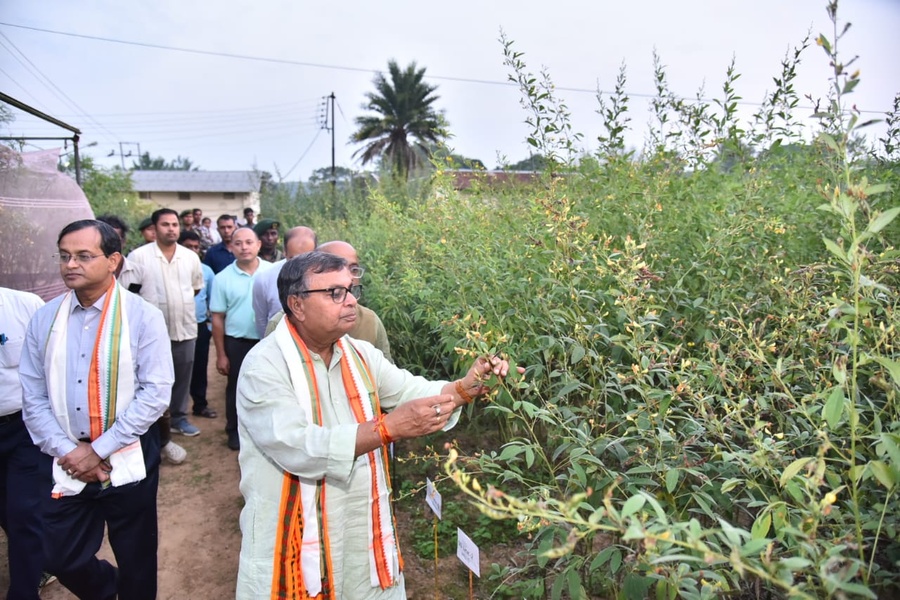
The Agriculture College of the state has discovered eight new varieties of Arhar Dal that are suitable for Tripura’s soil and weather. These will soon be distributed among farmers with the aim of making the state self-sufficient in pulse production.
This information was shared by Agriculture and Farmers’ Welfare Minister Ratan Lal Nath today.
The Minister said this after visiting the Agriculture College at Lembuchara. He mentioned that earlier, only the undergraduate course was available at the college, but from 2021, PG courses have also been introduced. At present, around 200 students are admitted every year — 60 in UG courses and 18 in PG courses across three departments.
“Many of the students, especially in the UG courses, are from Tripura. Admissions are conducted through the joint entrance examination, and outside students are not allowed for UG programs. However, in the case of PG courses, students from outside the state are allowed. In recent times, there has been growing enthusiasm among girls to pursue a B.Sc. in Agriculture, which is a good sign,” said the Minister.
The Minister remarked that if agriculture is destroyed, everything will be destroyed.
He added that India is self-sufficient in rice, milk, eggs, fish, and other agricultural products.
“There was a time when India used to import rice and wheat, but now we export these to other countries. However, in the case of pulses, we are still lagging behind and import certain quantities from abroad. To achieve self-sufficiency, the Central Government has launched the National Mission on Pulses. Prime Minister Narendra Modi wants India to become self-sufficient in every sector,” he said.
He informed that after ten years of research by scientists including Dr. Biman Dey (Agronomist), Dr. D.P. Awasthi (Plant Pathology), and Dr. B.C. Thangjam (Entomology), eight varieties of Arhar Dal have been developed under their leadership. Before 2018, the average yield per hectare was 705 kg, which increased to 823 kg per hectare after 2018.
“Due to the soil and weather conditions, these eight varieties are highly suitable and yield around 2000 kg per hectare. The research team has submitted their report, and soon we will hand these varieties over to our farmers. This research started in 2009–2010 with support from ICAR and the Tripura Government. In the coming days, we will become self-sufficient in pulses,” said the Minister.
The Minister further stated that earlier it was believed onion cultivation was not possible in Tripura, but now both red and white onions are being cultivated in large quantities. Farmers are now demanding onion seeds. In 2017–18, onion was cultivated over 163 hectares, and by 2025–26, it will reach 225 hectares.
“This year, we have focused on ARC potato and onion production, and soon we will be self-sufficient,” he added.