Tripura Santiniketan Medical College has issued a comprehensive academic audit report following the declaration of the First Professional MBBS Examination results (Tripura University, September 2025). This detailed report effectively serves as a response to certain criticisms recently highlighted in sections of the media.
While maintaining transparency in its training and evaluation processes, the college administration has candidly outlined the challenges encountered and has clearly defined the roadmap for future academic strengthening and reform.
According to the report, the college undertook a comprehensive academic audit to understand the performance trends of its inaugural MBBS batch. The analysis underscored several systemic and regulatory constraints impacting student preparedness.
“A key factor identified was the mandatory early commencement of academic sessions prior to the completion of NEET-UG counselling. As a result, many students admitted in later rounds missed nearly one month of early foundational teaching – a challenge that also affected the previous session. Despite access to recorded lectures and online learning materials, the college noted that virtual learning could not fully bridge the gap created by missed classroom interaction,” informed Prof. Dr. Sanjay Nath, Principal of Tripura Santiniketan Medical College.
He also informed that the audit further pointed to the loss of Foundation Course exposure for late-admitted students. This CBME-designed introductory programme is considered crucial for orienting new entrants to professional behaviour, ethics, communication skills and self-directed learning.
College officials informed, another academic strain arose from the reduction of the First Professional duration from 18 months to 12 months, as mandated nationally. Accounting for holidays and examination schedules, the effective teaching time stands at approximately 10 months, intensifying the learning schedule and competency delivery.
Additionally, it has found that in the absence of a State Health University, uniformity in curriculum blueprinting and assessment mapping remains a challenge, with examination weightage not always proportionately aligned with the competency matrix. The transition from MCQ-based NEET testing to descriptive university exams was also highlighted as a factor requiring adjustment in student learning and writing skills.
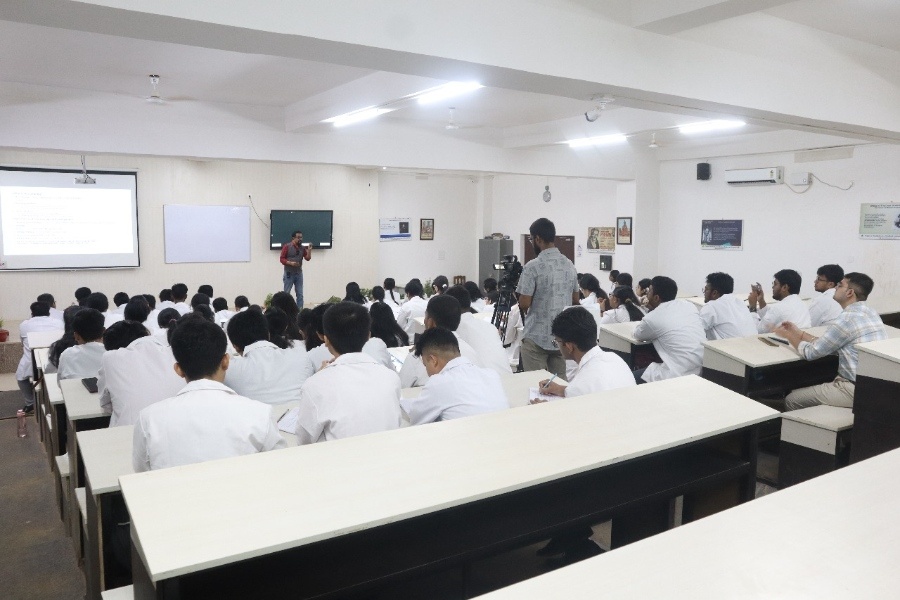
Despite these challenges, the institution emphasized its proactive measures, stating that it has exceeded NMC-mandated teaching hours – 620 hours in Anatomy, 445 hours in Physiology and 249 hours in Biochemistry. All academic sessions were live-streamed and archived, reinforcing CBME-driven self-learning practices. Periodic remedial classes, wellness and stress-management support and examination-skills workshops were conducted to strengthen learner readiness.
College officials also informed that due strict adherence to NMC norms was maintained, as 25 students who did not meet attendance or internal assessment criteria were not permitted to appear for final examinations. Focused remedial and bridging programmes have now been rolled out for detained and unsuccessful candidates.
Notably, college authorities celebrated the strong showing of several students, including one who secured 4th position in the overall University merit list, underscoring the promising academic potential of the inaugural batch.
In a statement, the institution reaffirmed its commitment to continuous quality enhancement, structured mentorship, and outcome-driven learning. “As the first batch of the college, the performance provides critical learning inputs. We remain dedicated to strengthening academic systems in full compliance with the NMC CBME framework and driving excellence through sustained improvement,” the college noted.
With corrective plans underway and institutional support reinforced, Tripura Santiniketan Medical College expressed confidence that subsequent cohorts will demonstrate elevated academic outcomes aligned with national medical-education standards.