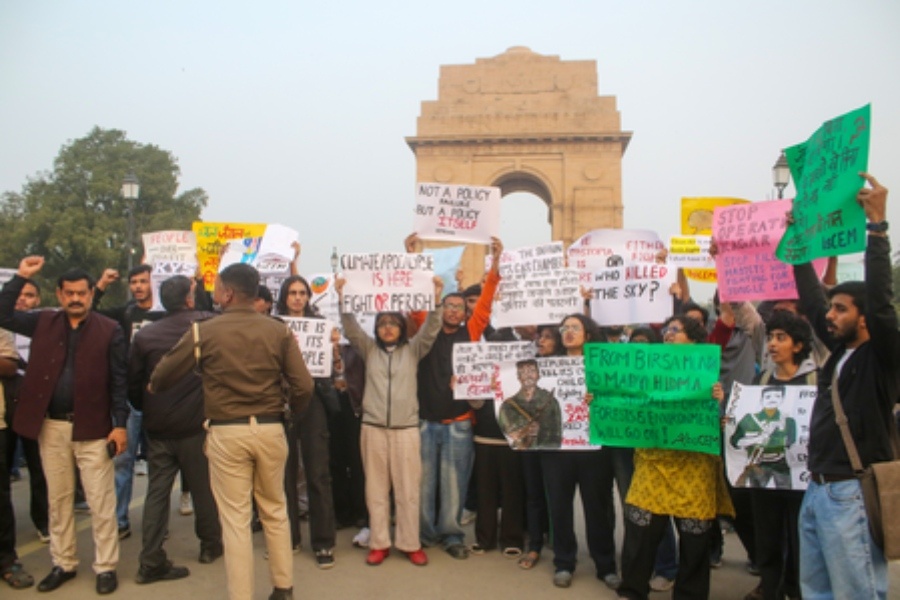
Fifteen student protesters were detained during a demonstration against worsening pollution levels in the Delhi-NCR region. Police confirmed on Monday that the detained individuals were taken to the Parliament Street Police Station for medical examinations.
According to officials, the protest took place at the C-Hexagon near India Gate, where participants allegedly refused to disperse despite repeated police warnings.
An FIR has been registered under multiple sections, including charges related to obstructing government work. Police said the detainees include individuals picked up both from India Gate and outside the Parliament Street police station.
Authorities also alleged that some protesters used pepper spray during the demonstration, causing irritation to three to four policemen, who were taken to a hospital for treatment.
Officials said the protesters attempted to cross barricades placed to regulate movement in the area. Police personnel reportedly told them that ambulances and medical teams were stuck behind the blockade and required immediate passage, but the demonstrators allegedly became “agitated.”
When the group pushed through barricades and sat on the road, police intervened and removed them from the C-Hexagon to prevent disruption in the high-traffic zone.
Sunday’s incident comes days after several people were detained during a November 9 “clean air protest” at India Gate, where citizens demanded urgent government action to address what they called an “air emergency” in the national capital.
The ongoing protests coincide with rapidly declining air quality in Delhi, where many areas are now recording AQI levels between 300 and 400. Several pockets have already crossed the 400 mark, entering the ‘severe’ category. Neighbouring cities are also experiencing hazardous pollution: Faridabad reported an AQI of 358, Gurugram 370, Ghaziabad 355, Greater Noida 342, and Noida 372.
With pollution worsening, the Commission for Air Quality Management (CAQM) on Saturday revised the Graded Response Action Plan (GRAP). Measures previously reserved for Stage IV (‘severe’) will now be enforced at Stage III, including uninterrupted power supply to curb diesel generator use, additional personnel at traffic choke points, widespread pollution alerts, and expansion of CNG and electric public transport services.
Several restrictions earlier under Stage III have been moved to Stage II, such as staggered working hours for government offices in Delhi, Gurugram, Faridabad, Ghaziabad and Gautam Buddh Nagar. The Centre may also consider similar steps for its offices.
Additionally, restrictions such as allowing government and private offices to function with only 50 per cent staff—originally meant for Stage IV—will now apply during Stage III alerts.
With the air quality continuing to dip, the Delhi government has instructed private offices to operate with 50 per cent staff on-site, allowing the rest to work from home as a precaution.