A sudden spell of intense nor’wester storms in mid-March brought normal life to a standstill across several districts of Tripura, severely disrupting the state’s power supply network.
Triggered by violent winds and heavy rainfall even before the second half of March had properly set in, the extreme weather event left large swathes of the state in darkness for days.
Yet, in what comes as a major relief, the Tripura State Electricity Corporation Limited managed to restore power in most affected areas within a remarkably short span, reaffirming its commitment to uninterrupted service for consumers. However, officials acknowledge that rebuilding the heavily damaged infrastructure will be a demanding task in the coming days.
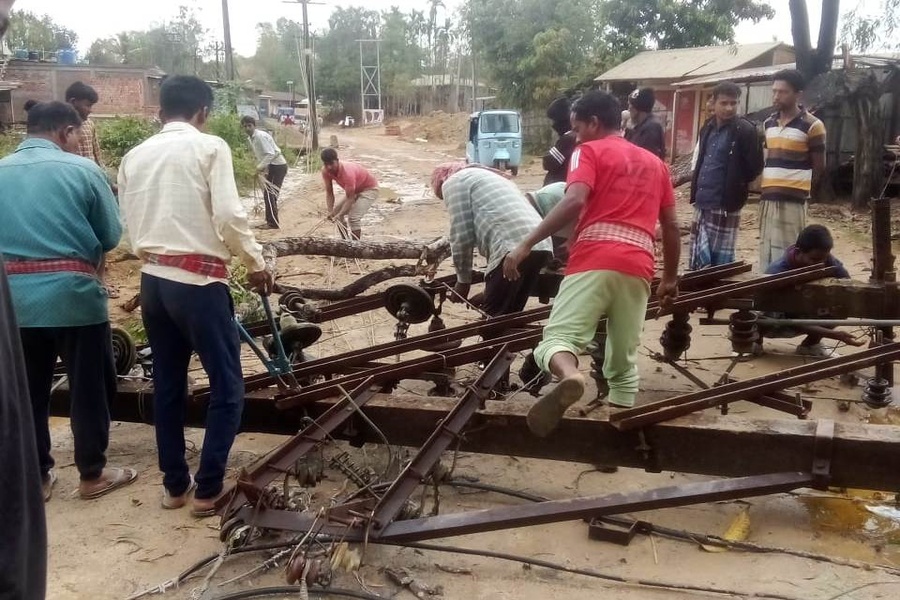
The storms, which lashed the state between March 13 and March 22, caused widespread damage across all eight districts. Uprooted roadside trees snapped power lines, while electric poles collapsed one after another under the force of the winds. From remote rural belts to urban centers, vast regions plunged into darkness.
The impact was particularly severe in districts like Dhalai, Unakoti, and Khowai, where high-voltage transmission lines were seen lying broken on the ground. In several locations, damaged transformers led to prolonged outages, directly affecting daily life and essential services.
Amid this crisis, TSECL faced a dual challenge, assessing massive infrastructure losses while simultaneously restoring electricity supply.
Managing Director Biswajit Basu stated that the utility has suffered financial losses exceeding Rs 2 crore due to the unseasonal disaster. Preliminary assessments indicate that every district experienced some degree of infrastructure damage.
According to Basu, more than 90 kilometers of transmission lines were completely damaged across the state. In addition, over 400 electric poles were destroyed, and at least 37 transformers were rendered non-functional. Even substations in North Tripura were not spared by the storm’s intensity.
Providing a breakdown of the damage, he said that in the Dhalai circle alone, around 25 kilometers of lines were affected and over 17 poles were damaged, resulting in losses exceeding 50 lakh. The Unakoti circle reported 43.9 kilometers of snapped lines, along with 22 poles and 5 transformers rendered unusable. Khowai witnessed even more extensive destruction, with nearly 53 kilometers of lines affected, 44 poles damaged, and 11 transformers failing.
In Sepahijala, storms on March 13 and 18 caused 106 poles to collapse, damaged 26.9 kilometers of lines, and affected 8 transformers and 8 substations. South Tripura recorded the highest number of fallen poles at 109, along with damage to 37.3 kilometers of lines. Gomati reported 9.33 kilometers of damaged lines, 75 poles down, and 13 transformers failing. In North Tripura, around 16 kilometers of lines were damaged, over 18 poles collapsed, and 4 substations were hit.
Despite the scale of destruction, what stands out is the relentless response of TSECL personnel. Working in hazardous conditions and adverse weather, teams were deployed round the clock in what officials described as a war-footing operation. Crews repaired snapped lines, replaced damaged poles, and restored faulty transformers with urgency and precision.
As a result, electricity supply was restored in most affected areas within 1 to 3 days, significantly reducing prolonged hardship for residents. This rapid restoration effort highlights the corporation’s strong service commitment toward power consumers across the state.
Officials confirmed that detailed damage reports have been submitted to the respective district administrations. Basu also urged citizens to remain cautious, warning against approaching snapped wires or damaged poles during such disasters, as they pose serious risks. He appealed to the public to immediately report any such hazards to the nearest electricity office.